

Official websites use .gov
A
.gov
website belongs to an official government organization in the
United States.

Secure .gov websites use HTTPS
A
lock
(
) or
https://
means you’ve safely connected to the .gov website. Share sensitive
information only on official, secure websites.

 Data Briefs
Trends in Individuals’ Access, Viewing and Use of Online Medical Records and Other Technology for Health Needs: 2017-2018
No. 48 | May 2019

The access, exchange, and use of electronic health information is essential for individuals to better manage their health care needs and share information with their providers and caregivers. Many hospitals and physicians possess capabilities that enable patients to view and download their health information. However, additional steps are needed to make health information more accessible and useful to individuals (1, 2). A majority of individuals have smartphones and use applications (apps) to help them manage various tasks. The 21st Century Cures Act emphasizes the importance of making patient health information more easily accessible and the need for greater education regarding patients’ rights to access their health information (3). This data brief uses the Health Information Trends Survey (HINTS), a nationally representative survey, to assess individuals’ access, viewing and use of their online medical records, and the use of smartphone health apps and other electronic devices in 2017 and 2018.
Highlights
- The percentage of individuals who were offered access to their online medical record did not change between 2017 (52%) and 2018 (51%).
- In 2018, about 3 in 10 individuals were offered access to their online medical record and viewed their record at least once within the past year.
- Individuals’ rates of being offered access and viewing their online medical records at least once in the past year varied by their health care use, socio-demographic characteristics, Internet access and use, and health.
- Among individuals who viewed their online medical record at least once in the past year, the percentage that downloaded their health information increased by about one-third between 2017 and 2018.
- In 2018, half of smartphone or tablet owners had health or wellness apps which were commonly used to track progress towards a health-related goal (75%).
The percentage of individuals offered access to their online medical record did not change between 2017 and 2018.
Figure 1: Percent of individuals ever offered access to their online medical record by a health care provider or insurer by whether they viewed their online medical record, 2014-2018
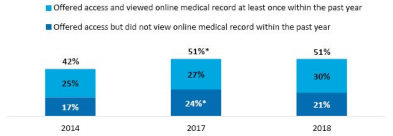
Notes: *Significantly different from previous year (p<0.05). Denominator represents all individuals. Percentage reflects weighted national estimate.
- In 2018, three in 10 individuals were offered access to their online medical record and viewed their record at least once within the past year
Among individuals who had been offered access to an online medical record, nearly six in 10 viewed their record at least once in 2018.
Figure 2: Frequency of viewing an online medical record within the past year among those who had been offered an online medical record by a health care provider or insurer, 2017-2018.
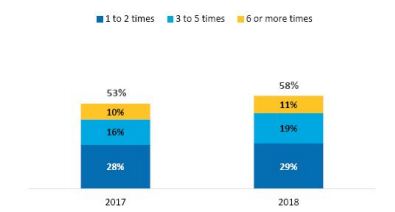
Note: Numbers do not add up to 58% due to rounding. Denominator represents individuals who were offered access to their online medical record (52% of individuals nationwide in 2017; 51% of individuals nationwide in 2018).
- Between 2017 and 2018, there were no differences in frequency of viewing online medical records.
- In 2018, among individuals who were offered access to their online medical record, about three in 10 individuals viewed their data one to two times per year.
- In 2018, among individuals offered access to their online medical record, only about one in 10 viewed their data six or more times within the past year.
Individuals’ viewing of online medical records varied by their health care usage, rural/urban location, socio-demographic characteristics, Internet access and use, and overall health.
Table 1: Variation in individuals being offered and accessing their online medical records by selected characteristics, 2017-2018 (combined sample)
| Characteristic | % Individuals who were offered access to online medical records by characteristic (2017-2018) | Among individuals offered an online medical record, % who viewed their record by characteristic (2017-2018) | |
|---|---|---|---|
| Gender | Male (reference) | 45% | 54% |
| Female | 57%*^ | 58% | |
| Annual Household Income | $0 to $34,999 | 36%*^ | 41%*^ |
| $35,000 to $74,999 | 49%*^ | 53%*^ | |
| $75,000 or more (reference) | 65% | 66% | |
| Education | College Degree or more | 63%*^ | 68%*^ |
| Less than College (reference) | 46% | 48% | |
| Internet access and use | Yes | 57%*^ | 59%*^ |
| No (reference) | 26% | 24% | |
| Geography | Urban | 52%* | 57%*^ |
| Rural (reference) | 45% | 45% | |
| Doctor Visit in Past Year | Yes | 57%*^ | 58%*^ |
| No (reference) | 27% | 38% | |
| Health Insurance Coverage | Yes | 54%*^ | 57%* |
| No (reference) | 25% | 34% | |
| Have a Chronic Condition | Yes | 55%*^ | 57%^ |
| No (reference) | 46% | 54% | |
Notes: Unadjusted weighted national estimate shown. *Unadjusted estimate significantly different from reference category (p<0.05). ^Adjusted estimate (not shown) significantly different from reference category (p<0.05). The adjusted estimates controlled for survey year (2017/2018), gender, age, race/ethnicity, income, education, geography, having seen a doctor in the past year, internet access, chronic condition, and health insurance. Chronic condition was defined as having at least one of the following conditions: diabetes, hypertension, chronic heart disease, chronic lung disease, arthritis, or a mental health condition.
- Access to online medical records varied by individuals’ health care use, socio-demographic characteristics, Internet access and use, and by whether they had a chronic health condition.
- Individuals with an annual household income of $75,000 were more likely to be offered access as well as view their online medical record compared to those with less income.
- Individuals who went to the doctor at least once within the past year were twice as likely to be offered access to their online medical record, and were over 50 percent more likely to view their online medical record at least once compared to those who did not visit their doctor within the past year.
- Individuals with at least a college degree had higher rates of being offered access and subsequently viewing their online medical records compared to those with less than a college degree.
- Individuals with chronic health conditions were more likely to be offered access and view their online medical records compared to individuals without chronic health conditions.
Most individuals cited their preference to speak to a provider directly and perceived lack of need as reasons for not viewing their online medical records in 2017 and 2018.
Table 2: Reasons for not accessing online medical record as reported by individuals who did not view their online medical record within the past year, 2017-2018.
| Reason for Not Using Online Record | 2017 | 2018 |
|---|---|---|
| Prefer to speak to health care provider directly | 76% | 73% |
| Did not have a need to use your online medical record | 59% | 65% |
| Concerned about the privacy/security of online medical record | 25% | 14%* |
| No longer have an online medical record | 19% | 13% |
| Do not have a way to access the website | 20% | 10%* |
Note: *Significantly different from previous year (p<0.05). Denominator represents individuals who were offered an online medical record but did not view their record within the past year.
- About three-quarters of individuals cited their preference to speak with their health care provider directly as a reason for not using their online medical record within the past year.
- The percent of individuals who did not view their online medical record within the past year due to privacy and security concerns decreased by 11 percentage points between 2017 and 2018.
- Individuals who went to the doctor at least once within the past year were twice as likely to be offered access to their online medical record, and were over 50 percent more likely to view their online medical record at least once compared to those who did not visit their doctor within the past year.
- Fewer individuals reported not having a way to access their online medical record’s website as a reason for not viewing their record in 2018 compared to 2017.
Nearly eight in 10 individuals who viewed their online medical record reported that it included summaries of their office visits in 2018.
Table 3: Types of information reported in individuals’ medical record amongst those who were offered and viewed their record within the past year, 2017-2018.
| Type of Information | 2017 | 2018 |
|---|---|---|
| Clinical notes | 51% | 51% |
| Immunization or vaccination history | 55% | 58% |
| Allergy list | 62% | 61% |
| List of health/medical problems | 70% | 72% |
| Summaries of your office visit | 76% | 78% |
| Current list of medications | 79% | – |
| Laboratory test results | 92% | – |
Note: Denominator represents individuals who were offered access to the online medical record and viewed their online medical records at least once within the last year. Data for Current List of Medications and Laboratory Test Results were not collected in 2018.
- There were no changes in the availability of specific types of information in individuals’ online medical records between 2017 and 2018.
- In 2018, about six in 10 individuals who viewed their online medical record reported having access to their vaccination history and allergy list.
- A majority of individuals who had viewed their online medical record indicated that it included a list of their health/medical problems and summaries of their office visits.
- Among individuals who had viewed their online medical record within the past year (representing 30% nationally), about half indicated clinical notes were included in their online medical record.
In 2018, the percent of individuals who viewed their online medical record and downloaded their record data increased by over 30 percent.
Table 4: Among those viewed their record at least once within the past year, the percentage that used view, download, or transmit functionalities 2017-2018.
| View, Download or Transmit | 2017 | 2018 |
|---|---|---|
| View test results | 84% | – |
| Download online medical record data | 17% | 26%* |
| Transmitted data to at least one outside party listed below | 14% | 17% |
| Transmit to another healthcare provider | 10% | 14% |
| Transmit to caregiver | 4% | 4% |
| Transmit to service or app | 3% | 3% |
Note: *Significantly different from previous year (p<0.05). Denominator represents individuals who viewed their online medical records at least once within the last year (30% of respondents). Data for View Test Results was not collected in 2018.
- One quarter of individuals who viewed their online medical record also downloaded their data in 2018.
- In 2018, nearly one in five individuals who viewed their online medical record also transmitted their data to an outside party (another healthcare provider, caregiver, or app/service).
- In 2017 and 2018, only three percent of individuals who viewed their record within the past year transmitted their record data to a service or app.
Half of individuals that viewed their online medical record used it to communicate with their health care providers via secure messaging in 2018.
Table 5: Reported online medical record functionalities used by individuals amongst those who were offered and viewed their record, 2017-2018.
| Uses of Online Medical Record | 2017 | 2018 |
|---|---|---|
| Convenience Functions | ||
| Request refill of medications | 38% | 39% |
| Fill out forms or paperwork related to your health care | 38% | 44%* |
| Updating Medical Record | ||
| Request correction of inaccurate information | 8% | 7% |
| Add health information | 19% | 24% |
| Communicating with Health Care Provider | ||
| Securely message health care provider and staff (e.g., e-mail) | 48% | 53% |
| Decision Making | ||
| Help you make a decision about how to treat an illness or condition | 19% | 24% |
| Perceptions regarding Usefulness of Online Medical Record | ||
| Consider online medical record useful for monitoring health | 84% | 83% |
Note: Denominator represents individuals who were offered access to the online medical record and viewed their online medical records at least once within the last year.
- Among those who viewed their online medical record, about four in 10 used it to request medical refills and fill out forms related to their health care in 2018.
- The percent of individuals who reported using their online medical record to fill out forms related to their health care increased by six percentage points between 2017 and 2018.
- Among individuals who viewed their online medical record, about 10 percent requested corrections to their online medical record in 2018.
- More than eight in 10 individuals who viewed their record reported that their online medical record was useful for monitoring their health in 2018.
In 2018, half of smartphone or tablet owners used a health or wellness app
Table 6: Percent of individuals who reported having a smartphone, tablet, electronic monitoring device, or health and wellness app, 2017-2018.
| Type of Device | 2017 | 2018 |
|---|---|---|
| Electronic Monitoring Device (e.g., Fitbit, blood glucose meter, blood pressure device) | 34% | 35% |
| Tablet | 62% | 58% |
| Smartphone | 79% | 80% |
| Tablet or Smartphone | 84% | 84% |
| Health and Wellness App (among those with a tablet or smartphone) | 44% | 49% |
Note: Examples of an electronic monitoring device include Fitbit, blood glucose meter, and/or blood pressure monitor
- The proportion of individuals who reported owning a tablet, smartphone, or other electronic monitoring device did not change between 2017 and 2018.
- Over eight in 10 individuals reported owning a tablet or smartphone in 2018.
- One-third of individuals owned an electronic monitoring device such as a Fitbit, blood glucose meter, or blood pressure monitor in 2018.
Three-quarters of individuals with a health and wellness app used it to track progress on a healthrelated goal in 2018.
Table 7: : Percent of individuals who reported using their health and wellness app or other electronic monitoring device to help discuss, track, and/or make decisions regarding their health, 2017-2018.
| Use of Electronic Device | 2017 | 2018 |
|---|---|---|
| Individuals with a health & wellness app1 | ||
| Track progress on a health-related goal | 69% | 75%* |
| Make a decision about how to treat an illness or condition | 45% | 48% |
| Discuss your health with your health care provider | 43% | 45% |
| Individuals with a health & wellness app or other electronic monitoring device2 | ||
| Shared information from a smartphone, tablet, or other electronic monitoring device with a health professional | 26% | 28% |
Note: *Significantly different from previous year (p<0.05). Examples of an electronic monitoring device include Fitbit, blood glucose meter, and/or blood pressure monitor. 1Denominator represents the sample of individuals that report having a health and wellness app; 2Denominator represents the sample of individuals that report having a health and wellness app or electronic monitoring device.
- The percentage of individuals who had a health and wellness app and used it to track progress on a healthrelated goal increased by six percentage points between 2017 and 2018.
- In 2018, about half of individuals with a health and wellness app used it to make a decision about how to treat an illness or condition; a similar number used it to facilitate discussions with their health care provider.
- More than a quarter of health and wellness app or other electronic monitoring device users shared information from their device with a health professional in 2018.
In 2018, one in five individuals owned a tablet or smartphone and were offered access to their online medical record but had not viewed their record within the past year.
Figure 3: Percent of individuals who were offered access and subsequently viewed their online medical record by whether they owned a smartphone/tablet, 2018.
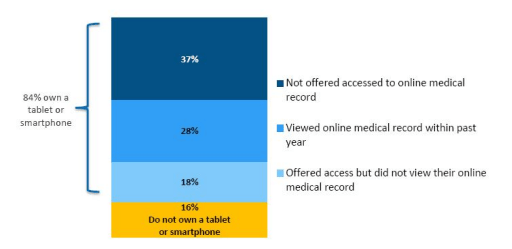
Notes: Denominator represents all individuals. Percentage reflects weighted national estimate. Percentages do not add up to 84% due to rounding.
- Almost three in 10 individuals owned a smartphone or tablet and viewed their online medical record at least once within the past year.
- Over one-third of individuals owned a smartphone or tablet and were not offered access to an online medical record.
Summary
Individuals’ rates of access and frequency of viewing their online medical records did not change between 2017 and 2018. In 2018, about half of individuals were offered online access to their medical record by a health care provider or insurer. Among these individuals, 58 percent viewed their online medical record at least once within the past year. Nationally, this represents about three in 10 individuals. With the exception of using online medical records to download health information and fill out paperwork, individuals’ use of other functionalities remained similar to 2017. The availability of specific types of information in individuals’ online medical records also did not change.
Individuals who did not view their online medical record most commonly cited their preference to communicate directly with health care providers (rather than using the online medical record) and a perceived lack of need. The percent of individuals citing privacy and security concerns as reasons for not viewing their online medical record dropped considerably in 2018. This might reflect an increase in the percentage of individuals nationally who express confidence that safeguards are in place to protect medical records from unauthorized viewing (4).
Individuals’ rates of being offered and viewing their online medical record varied by factors related to health care access and use, socio-demographic characteristics, Internet use, and health. For example, individuals who had a doctor visit within the past year were twice as likely to be offered access to their online medical record compared to those who did not see their doctor. After adjusting for a variety of factors, including health care access and use, individuals with higher income and greater education were more likely to be offered access and subsequently view their online medical record. This suggests greater efforts are needed to offer access and encourage usage of online medical records across all individuals. Both ONC’s Patient Engagement Playbook and Guide to Getting and Using your Health Record offer tips to providers and patients, respectively, that can make this process easier.
About eight in 10 individuals in 2018 had a tablet or smartphone. Among these individuals, about half had a health or wellness app. Encouragingly, three-quarters of health or wellness app users tracked progress on health-related goals and about half used their apps to make treatment-related decisions. Moreover, almost three in 10 individuals who owned a health and wellness app or an electronic monitoring device shared information from these devices with health care providers. However, few individuals reported transmitting their online medical record data to a health app. This may be related to providers’ limited capabilities in offering this function (1, 2).
Making it easier for individuals to use apps to access, view, and subsequently share their online medical record data may enable individuals to better manage their health and address gaps in interoperability. ONC’s proposed rule seeks to make patient health information from electronic health records accessible through application programming interfaces (APIs) (3). APIs are technology that allow a software developer to create programs and mobile apps that interact with another software without needing to know the “internal” workings of that software. The rule, as proposed, promotes the creation of apps that would enable individuals to more easily access and use their personal health information (5). One in five individuals had a smartphone or tablet and were offered access to an online medical record but did not view their record within the past year. Usage of online records by smartphone and tablet users, could increase if apps that provided access to view medical record data were widely available; such apps are being piloted by some health systems (6, 7). ONC’s recent proposed rule would make it easier for health IT developers to make such products widely available, allowing individuals to more easily access, exchange, and use their health information (5).
Definitions
Definitions for variables derived by ONC during this analysis are described below:
Offered access to an online medical record: Individuals were considered to be offered access to an online medical record if they responded “yes” to either health care provider or insurer for the question, “Have you ever been offered online access to your medical records by: a) health care provider? b) health insurer?”
Ease of Understanding the Health Information in Your Online Medical Record: Health information was considered “Easy to Understand” if an individual responded “Very easy” or “Somewhat easy” to the question, “How easy was it to understand the health information in your online medical record?” Health information was considered “Difficult to Understand” if an individual responded “Very difficult” or “Somewhat difficult” to the same question.
Data Source and Methods
Data are from the National Cancer Institute’s (NCI) Health Information National Trends Survey (HINTS). Since 2003, NCI has sponsored HINTS to assess the impacts of health communication, specifically measuring: how people access and use health information, how people use information technology to manage their health and health information, and the degree to which people are engaged in health behaviors.
ONC staff, working with the National Partnership of Women and Families and NCI, developed the survey content related to health IT use for HINTS 5. HINTS 5, Cycle 2 (2018) data were collected from January through May 2018. The sample design for HINTS 5, Cycle 2 (2018) consisted of a single-mode mail survey, using the Next Birthday Method for respondent selection.
The sample design for the HINTS 5, Cycle 2 (2018) survey consisted of two-stages. In the first stage, a stratified sample of addresses was selected from a file of residential addresses. In the second-stage, one adult was selected within each sampled household. The sampling frame consisted of a database of addresses used by Marketing Systems Group (MSG) to provide random samples addresses. Complete data were collected from 3,527 respondents. The response rate was in 33%, and results were weighted to account for non-response and generate national estimates.
The analyses conducted in this data brief primarily focused on questions from sections B and D. The questions asked in the HINTS 5, Cycle 2 (2018) survey can be found at https://hints.cancer.gov/docs/Instruments/HINTS5_Cycle2_Annotated_Instrument_English.pdf
References
- Office of the National Coordinator for Health Information Technology. ‘U.S. Hospital Adoption of Patient Engagement Functionalities,’ Health IT Quick-Stat #24. dashboard. healthit.gov/quickstats/pages/FIG-Hospital Adoption-of-Patient-Engagement-Functionalities.php. September 2016.
- Office of the National Coordinator for Health Information Technology. ‘Office-based Physician Electronic Patient Engagement Capabilities,’ Health IT Quick-Stat #54. dashboard.healthit.gov/quickstats/pages/physicians-view download-transmit-secure-messaging-patient-engagement.php. December 2016.
- 21st Century Cures Act, section 4006. https://www.gpo.gov/fdsys/pkg/PLAW-114publ255/pdf/PLAW 114publ255.pdf
- Office of the National Coordinator for Health Information Technology. ‘Individuals’ Perceptions of the Privacy and Security of Medical Records and Health Information Exchange,’ Health IT Quick-Stat #58. dashboard.healthit.gov/quickstats/pages/consumers-privacy-security-medical-record-information-exchange.php. May 2018.
- Office of the National Coordinator for Health Information Technology. Notice of Proposed Rulemaking to Improve the Interoperability of Health Information. https://www.healthit.gov/topic/laws-regulation-and policy/notice-proposed-rulemaking-improve-interoperability-health
- KLAS. Apple Health Records 2018: Early Participants Weigh In. 2018. https://klasresearch.com/report/apple health-records-2018/1364
- Christian Dameff; Brian Clay; & Christopher A. Longhurst. Personal Health Records More Promising in the Smartphone Era? JAMA. January 29, 2019. https://jamanetwork.com/journals/jama/fullarticle/2721088
Acknowledgements
The authors are with the Office of Technology, within the Office of the National Coordinator for Health Information Technology. The data brief was drafted under the direction of Mera Choi, Director of Technical Strategy and Analysis Division, and Talisha Searcy, Director of the Data Analysis Branch.
Suggested Citation
Patel V & Johnson C. (May 2019). Trends in Individuals’ Access and Use of Online Medical Records and Technology for Health Needs: 2017-2018. ONC Data Brief, no.48 Office of the National Coordinator for Health Information Technology: Washington DC.