

Official websites use .gov
A
.gov
website belongs to an official government organization in the
United States.

Secure .gov websites use HTTPS
A
lock
(
) or
https://
means you’ve safely connected to the .gov website. Share sensitive
information only on official, secure websites.

 Data Briefs
Electronic Access to Immunization Information among Primary Care Physicians
No. 70 | April 2024

State immunization information systems (IIS), also known as immunization registries, are population-based databases that record vaccinations administered by participating health care providers in a given state (1). Most states require providers to report certain vaccinations—frequently childhood immunizations—to their state’s IIS (2). IIS also became more commonly used to record adult vaccinations during the COVID-19 pandemic. Primary care physicians (PCPs), in particular, play a key role in administering and reporting immunizations to IIS, which are an important source of information for parents and the general public, as well as for assisting public health authorities with resource allocation, identifying populations at-risk for vaccine preventable disease, and informing programs to increase vaccination coverage (3). PCPs also benefit from the information available in IIS, which enable access to patients’ complete vaccination history and can help flag when patients are due for recommended vaccines. This data brief uses data on PCPs from the 2022 National Physician Health IT Survey to describe PCP satisfaction with their electronic access to external immunization information in their electronic health record (EHR) system and/or portal outside the EHR, and methods used to view immunization data from outside sources. This brief also describes PCPs’ awareness of their EHR’s capabilities to electronically report data to and access data from the IIS.
Highlights
- More than half of PCPs (58%) reported general satisfaction with their electronic access to external immunization information via their EHR and/or portal outside the EHR in 2022.
- A majority of PCPs used their EHR (41%) and/or portal outside the EHR (40%) to view immunization data from outside their organization. Less than a quarter of PCPs (22%) used other non-electronic methods such as paper or fax.
- PCPs who viewed immunization data through their EHR had the highest rates of satisfaction with their access to external immunization information.
- In 2022, about three-quarters of PCPs who viewed immunization data in their EHR indicated they were aware their EHR can access data from (77%) and report data to (74%) their state’s IIS.
In 2022, 1 in 5 PCPs reported being very satisfied with their electronic access to external immunization information in their EHR and/or via a portal outside the EHR.
Findings
- More than half of PCPs (58%) reported being “very” or “somewhat” satisfied with their electronic access to external immunization information.
- About one-third of PCPs reported being “not at all satisfied” with their electronic access to immunization information.
Figure 1: Primary care physicians’ satisfaction with their electronic access to immunization information in their EHR and/or portal outside the EHR
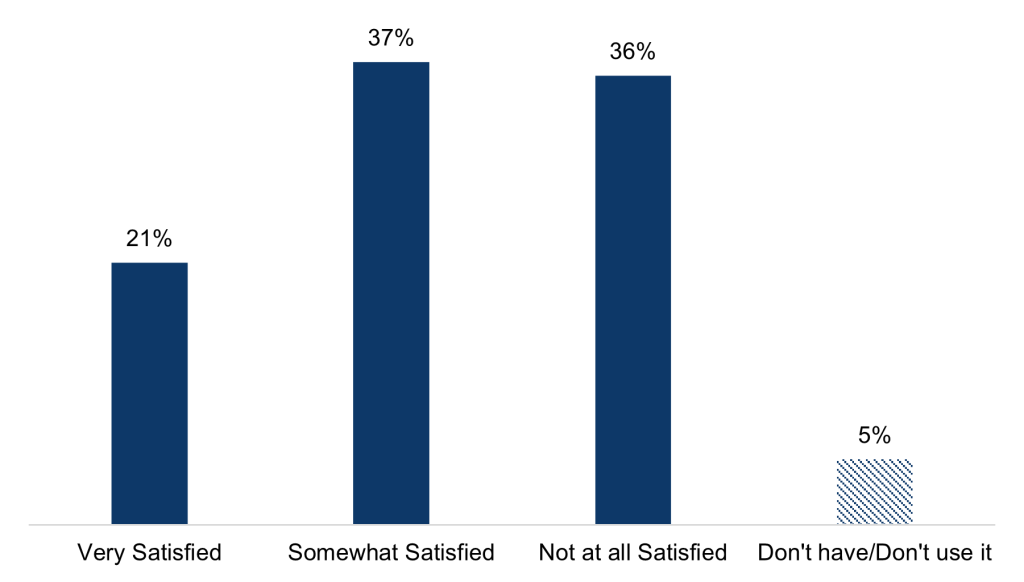
Notes: Denominator represents PCPs who provide outpatient care and use an EHR (N = 1,375). See Data Sources and Methods for a list of PCP sub-specialties. Missing and invalid responses were excluded from the denominator. See Appendix Table A1 for Survey Questions.
EHRs and portals outside the EHR were the most common methods used by PCPs to view immunization data from outside organizations.
Findings
- A majority of PCPs reported using electronic methods, including their primary outpatient EHR (41%) and/or a portal outside the EHR (40%), to view immunization data from outside their organization.
- Nearly one-quarter of PCPs (22%) reported using other non-electronic methods (such as paper or fax), and 15% reported being unable to view immunization data from outside their organization. Appendix Table A2 reports the share of PCPs using each method alone or in combination with other methods to view immuization data.
Figure 2: Method(s) primary care physicians reported using to view immunization data from outside their organization
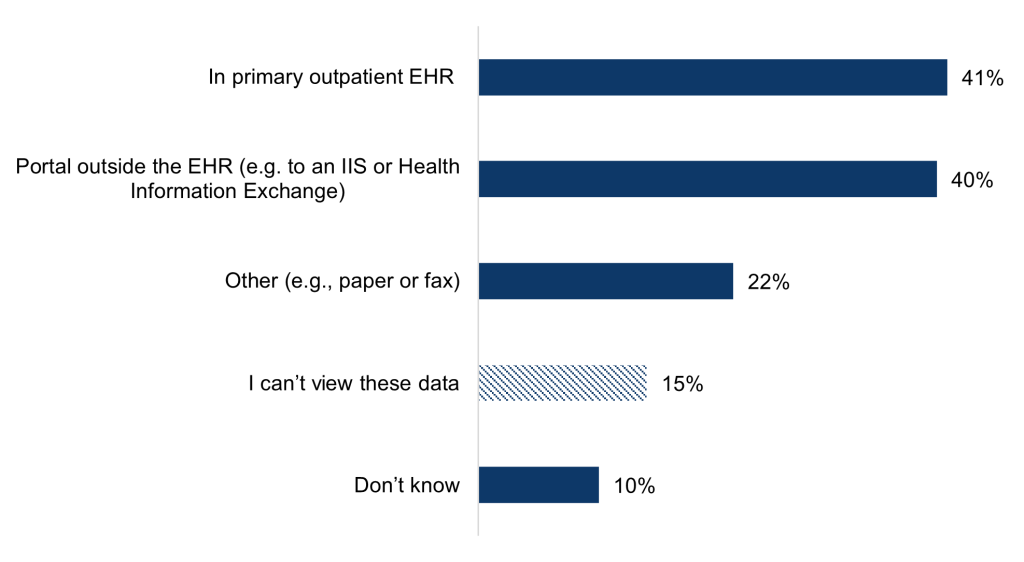
Notes: Denominator represents PCPs who provide outpatient care and use an EHR (N = 1,375). Missing and invalid responses were excluded from the denominator. Response options were not mutually exclusive. See Appendix Table A1 for Survey Questions.
PCPs who viewed immunization data through their EHR had the highest rates of satisfaction with their electronic access to external immunization information.
Findings
- Rates of satisfaction with electronic access to immunization data were highest among PCPs who reported viewing immunization data in their primary outpatient EHR (75%), either alone or in combination with other methods (see Appendix Table A2).
- Rates of satisfaction were lower among PCPs who reported viewing immunization data via a portal outside the EHR (62%) or other non-electronic methods (57%).
- About 2 in 3 PCPs who can’t view immunization data from outside organizations (15%) reported being unsatisfied with their lack of access, which may suggest nearly 10% of PCPs have a need for access that they are not able to resolve.
Figure 3: Primary care physicians’ satisfaction with their electronic access to immunization information, by method of viewing immunization data from outside organizations.
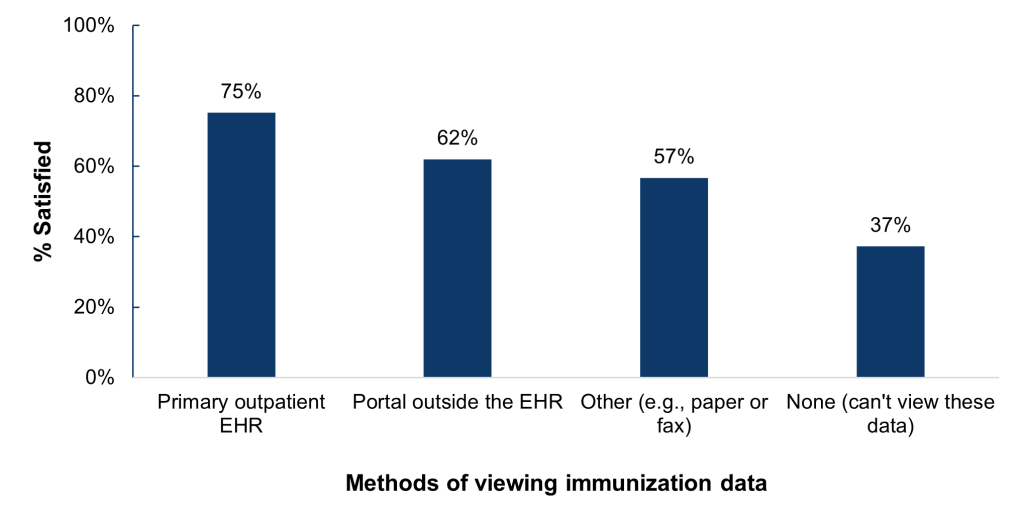
Notes: Denominator represents PCPs who provide outpatient care and use any of the following methods to view immunization data from outside organizations: Primary outpatient EHR (N = 624), Portal outside the EHR (N = 512), Other (e.g., paper or fax) (N = 286), None (can’t view these data) (N = 178). Except for “None (can’t view these data)”, response categories were not mutually exclusive. Missing and invalid responses were excluded from the denominator. See Appendix Table A2 for the number and share of PCPs who used each method or combination of methods to view immunization data from outside their organization, and how these relate to satisfaction.
In 2022, PCPs’ use of an EHR to view immunization data from outside organizations varied by practice characteristics.
Findings
- PCPs practicing in an integrated delivery system, HMO, health system or other prepaid practice used an EHR to view immunization data at higher rates than PCPs in other settings.
- PCPs in practices with 4 or more physicians and those participating in value-based care used an EHR to view immunization data at higher rates compared to their counterparts.
- Epic users had the highest rates of using an EHR to view immunization data (59%).
Table 1: Primary care physicians’ use of an EHR to view immunization data from outside organizations, by practice characteristics
| Practice Characteristics | % PCPs who use an EHR to view data |
|---|---|
| Main Setting | |
| Private or group practice, freestanding clinic or urgent care (N = 460) ref | 36% |
| Integrated Delivery System, HMO, health system or other prepaid practice (N = 117) | 58%* |
| Academic health center or faculty practice (N = 429) | 47%* |
| Hospital outpatient department (N = 114) | 45% |
| FQHC or Look-Alike or Rural Health Clinic (N = 166) | 40% |
| Other (N = 89) | 23%* |
| Practice Size | |
| 1 to 3 physicians (N = 279) ref | 27% |
| 4 to 10 physicians (N = 401) | 41%* |
| 11 to 50 physicians (N = 338) | 47%* |
| More than 50 physicians (N = 354) | 47%* |
| Value-based Care Participation | |
| Yes (N = 1,027) ref | 45% |
| No (N = 168) | 23%* |
| Don’t know (N = 179) | 33%* |
| EHR vendor | |
| Epic (N = 743) ref | 59% |
| Cerner (N = 123) | 37%* |
| eClinicalWorks (N = 88) | 31%* |
| athenahealth (N = 76) | 32%* |
| Other (N = 344) | 25%* |
| Region | |
| Midwest (N = 349) | 42%* |
| Northeast (N = 272) | 44%* |
| Southeast (N = 264) | 35% |
| Southwest (N = 106) ref | 28% |
| West (N = 384) | 47%* |
In 2022, about three-quarters of PCPs who used an EHR to view immunization data from outside organizations indicated they were aware their EHR can access data from and report data to their state’s IIS.
Findings
- About three-quarters of PCPs who used an EHR to view immunization data from outside organizations indicated their EHR can electronically access (query/find) immunization data directly from their state’s IIS (77%) and report immunization data to their state’s IIS (74%). However, rates of reported capabilities varied by primary care sub-specialty (see Appendix Table A3).
- About 1 in 5 PCPs who used an EHR to view immunization data reported being unaware of their EHR’s access (16%) and reporting (23%) capabilities. Lack of awareness of these capabilities also varied by primary care sub-specialty, signaling variation in PCPs’ understanding of their EHR’s technical capabilities.
Figure 4: Primary care physicians’ awareness of their EHR’s capabilities to access data from or report data to their state’s IIS (among those who use an EHR to view immunization data).
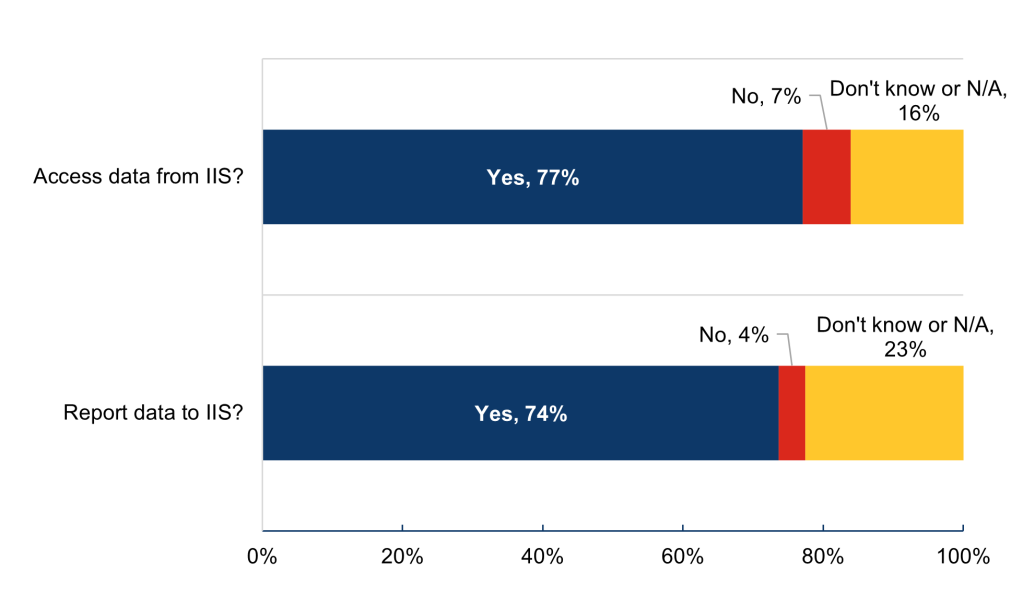
Notes: Denominator represents PCPs who provide outpatient care and use an EHR to view immunization data from outside organizations (N = 1,011). Missing and invalid responses were excluded from the denominator. See Appendix Table A1 for Survey Questions and Appendix Table A3 for individual primary care sub-specialty estimates.
Summary
Physician access to IIS data via their EHR or IIS portal outside the EHR enables quick and easy access to a patient’s full immunization history, helps keep track of a patient’s immunization status, and provides access to broader population data that can aid in clinical decision-making (4). Such access has been shown to improve vaccination rates, especially when used in tandem with clinical decision support tools integrated with the EHR to prompt physicians or office staff when a patient’s vaccinations are due (5,6). EHR-IIS connectivity is particularly important as it eliminates the burden of signing into a separate portal to access immunization data and helps ensure that patient immunization records are accurate and complete (7).
In 2022, more than half of PCPs (58%) reported satisfaction with their electronic access to external immunization information in their EHR or portal outside the EHR. However, only 21% were “very” satisfied and more than one-third of PCPs (36%) reported being “not at all” satisfied with their electronic access to this information. An analysis of these same questions in the 2022 American Board of Family Medicine (ABFM) Continuous Certification Questionnaire (CCQ) found similar levels of satisfaction among family medicine physicians (see Appendix Table A4). Overall satisfaction was highest among PCPs who viewed immunization data in their EHR (75%), followed by those who view immunization data via a portal outside the EHR (62%). Taken together, these findings suggest improving EHR-IIS connectivity—which would enable physicians to view immunization data in their EHR rather than an outside portal—would likely increase physician satisfaction with access to external immunization information. About 10% of PCPs do not have any access to immunization information from outside organizations but would like some type of access.
The share of PCPs who viewed immunization data from outside organizations in their EHR (41% overall) varied by practice characteristics. For instance, PCPs practicing in an integrated delivery system, HMO, health system or other prepaid practice (58%), as well as those in an academic health center or faculty practice (47%), reported the highest rates of viewing outside immunization data in their EHR compared to other practice settings. Further, PCPs working in larger practices and those participating in value-based care had higher rates of viewing external immunization data in their EHR (41 to 47% and 45%, respectively) compared to those working in smaller practices and not participating in value-based care. PCPs using Epic as their primary EHR vendor reported using their EHR to view immunization data from outside organizations at significantly higher rates (58%) than PCPs using other EHR vendors, including other leading vendors, Cerner (37%) and eClinicalWorks (31%). Reported rates of using an EHR to view immunization data from outside organizations varied regionally which may be due, in part, to regional differences in EHR vendor market share (see Appendix Table A5). For instance, PCPs in the Southeast and Southwest regions had significantly lower rates of using Epic—the leading EHR vendor by market share—who enables IIS-EHR connectivity. Regional differences may also reflect state-level variation in EHR vendor or IIS capabilities that we were unable to examine due to small samples in certain states.
In 2022, about three-quarters of PCPs who viewed immunization data in their EHR indicated they were aware their primary outpatient EHR was capable of electronically accessing immunization data from (77%) and reporting data to (74%) their state’s IIS. As a point of comparison, family medicine physicians who used an EHR to view immunization data reported similar capabilities of their EHR to access and report data to the IIS (Appendix Table A4). However, rates varied by primary care sub-specialty with pediatricians having the greatest awareness of their EHR’s capabilities to access data from or report data to their state’s IIS (see Appendix Table A3). This variation likely reflects differences in patient populations served as well as differences in reporting requirements for these populations (e.g., many states require reporting for child and adolescent vaccinations but not for adult populations). It is worth noting, however, that reported capabilities do not necessarily represent the actual capabilities of PCPs’ EHRs to report data to or access data from a state IIS. About 1 in 5 physicians who viewed immunization data through their EHR reported being unaware of their EHR’s IIS access (16%) and reporting (23%) capabilities, with certain primary care sub-specialties having higher rates of unawareness. Further research comparing PCP-reported capabilities to actual EHR capabilities would provide more insight into these differences and potential drivers. Variation in state laws around IIS reporting and opt-in vs. opt-out policies for patients may also drive some of the observed differences in providers’ awareness or use of their EHR’s access and reporting capabilities.
Several early and ongoing efforts have contributed to the current state of EHR-IIS connectivity, which requires providers to possess EHRs capable of connecting to IIS and for IIS to have the capacity to accept the connection and exchange immunization information. The Centers for Medicare & Medicaid Services’ (CMS) Promoting Interoperability (PI) performance category for Merit-Based Incentive Payment System (MIPS) eligible clinicians has been an important means of incentivizing provider reporting to IIS. Immunization registry reporting was an early requirement for eligible clinicians participating in the Medicare Meaningful Use Program (the early version of the PI program), and in 2022, became required again for MIPS eligible clinicians to encourage adoption and use of ONC-certified EHRs that are capable of transmitting data to immunization registries according to specified standards and implementation specifications aimed at promoting interoperability between EHRs and IIS (8,9,10).
On the public health side, the Centers for Disease Control and Prevention (CDC) in partnership with the American Immunization Registry Association (AIRA), the Health Information Management Systems Society (HIMSS), and the Drummond Group developed the Immunization Integration Program with the goal of improving immunization data interoperability and providing a means of testing EHR capabilities to exchange with IIS. Further, CDC’s National Center for Immunization and Respiratory Diseases (NCIRD), in partnership with AIRA, developed the Measurement and Improvement Initiative to assess IIS alignment with IIS Functional Standards which describe the technology needed for IIS to support vaccination providers and other immunization stakeholders.
Collectively, these efforts aim to encourage health IT developers to implement capabilities in their products to support immunization information exchange, incentivize immunization registry reporting among providers, and facilitate EHR-IIS connectivity. Our findings indicate that PCPs who used an EHR to view immunization data had the highest rates of satisfaction with their electronic access to immunization information and tended to report their EHR can access data from and report data to their state’s IIS. These findings demonstrate the overall success of efforts to promote interoperability of immunization information but also highlight room for improving EHR-IIS connectivity and PCP satisfaction with their access to external immunization information. With CDC’s Data Modernization Initiative efforts underway, improving interoperability of EHR and IIS systems could help improve physicians’ ability to report, access, and view immunization information needed to support patient care and population health. It will be important to work closely with federal partners to evaluate and maintain efforts to increase access and reporting to IIS.
Data Sources and Methods
Data are from the 2022 National Physician Health IT Survey, a nationally representative survey of office-based physicians. TheUniversity of California San Francisco (UCSF) in partnership with ONC and the American Board of Family Medicine (ABFM), surveyed U.S. outpatient physicians across specialty areas recruited from the Definitive Healthcare Physician Database. The survey was fielded April to November 2022, yielding a sample of 3,006 physicians who provided outpatient care and used an EHR (3.6% response rate). Analyses in this brief were restricted to primary care physicians (N = 1,375) which included the following sub-specialties: Family medicine (N = 448), Internal medicine, (N = 348), Obstetrics/Gynecology (N = 206), Pediatrics (N = 340), and other (N = 33). Results were weighted to account for non-response and generate national estimates.
References
- Centers for Disease Control and Prevention. About Immunization Information Systems [Internet]. Atlanta (GA): Centers for Disease Control and Prevention. Available from: About Immunization Information System (IIS) | CDC
- Kolman, Shannon. Lawmakers Turn to Data Systems to Guide Vaccine Decision-Making [Internet]. Washington (DC): National Conference of State Legislatures. Available from: Lawmakers Turn to Data Systems to Guide Vaccine Decision-Making – National Conference of State Legislatures (ncsl.org)
- Centers for Disease Control and Prevention. About Immunization Information Systems [Internet]. Atlanta (GA): Centers for Disease Control and Prevention. Available from: Basics of Immunization Information Systems (IISs) (cdc.gov)
- Centers for Disease Control and Prevention. IIS Frequently Asked Questions: What can an IIS do for a provider practice? [Internet]. Atlanta (GA): Centers for Disease Control and Prevention. Available from: IIS Frequently Asked Questions | CDC
- Vinci DM, Ryan J, Howard M, Snider D, Strahan B, Smith G, McClain R. Increasing Human Papillomavirus Vaccination in a Federally Qualified Health Center Organization Using a Systems-Based Intervention Integrating EHR and Statewide Immunization Information System. J Community Health. 2022 Feb;47(1):53-62. Available from: Increasing Human Papillomavirus Vaccination in a Federally Qualified Health Center Organization Using a Systems-Based Intervention Integrating EHR and Statewide Immunization Information System – PMC (nih.gov)
- Stephens AB, Wynn CS, Hofstetter AM, Kolff C, Pena O, Kahn E, Dasgupta B, Natarajan K, Vawdrey DK, Lane MM, Robbins-Milne L, Ramakrishnan R, Holleran S, Stockwell MS. Effect of Electronic Health Record Reminders for Routine Immunizations and Immunizations Needed for Chronic Medical Conditions. Appl Clin Inform. 2021 Oct;12(5):1101-1109. Available from: Effect of Electronic Health Record Reminders for Routine Immunizations and Immunizations Needed for Chronic Medical Conditions – PubMed (nih.gov)
- American Immunization Registry Association. EHR and IIS: Their Differences and How They Work Together [Internet]. Washington (DC): American Immunization Registry Association. Available from: EHR and IIS Their Differences and How They Work Together
- Office of the National Coordinator for Health Information Technology. Electronic Reporting to Immunization Information Services (IIS) among Medicare Eligible Professionals, 2011-2014, Health IT Quick-Stat #48 [Internet]. Washington (DC): Office of the National Coordinator for Health Information Technology. Available from: Electronic Reporting to Immunization Information Services (IIS) among Medicare Eligible Professionals, 2011-2014 | HealthIT.gov
- Centers for Medicare & Medicaid Services. Merit-Based Incentive Payment System (MIPS) Promoting Interoperability Performance Category Measure 2023 Performance Period [Internet]. Baltimore (MD): Centers for Medicare & Medicaid Services. Available from: Merit-Based Incentive Payment System (MIPS) Promoting Interoperability Performance Category Measure 2023 Performance Period (cms.gov)
- Office of the National Coordinator for Health Information Technology. §170.315(f)(1) Transmission to immunization registries [Internet]. Washington (DC): Office of the National Coordinator for Health Information Technology. Available from: Transmission to Immunization Registries (HealthIT.gov)
Acknowledgements
The authors are with the Office of Technology, within the Office of the National Coordinator for Health Information Technology (ONC). The data brief was drafted under the direction of Mera Choi, Director of the Technical Strategy and Analysis Division, Vaishali Patel, Deputy Director of the Technical Strategy and Analysis Division, and Wesley Barker, Chief of the Data Analysis Branch with subject matter expertise from Rachel Abbey, Kathleen Tully, and Molly Murray.
Suggested Citation
Richwine C, Strawley C. Electronic Access to Immunization Information among Primary Care Physicians. ONC Data Brief [Internet]. 2024 April; data brief 70.
Appendix
Appendix Table A1: National Physician Health IT Survey Questions
| Survey Questions | Response Options |
|---|---|
| Rate your current satisfaction with accessing the following types of external patient information electronically (within your EHR and/or portal): Immunizations | Not at all satisfied / Somewhat Satisfied / Very Satisfied / Don’t have/use it |
| Does your primary outpatient EHR electronically: (1) Report immunization data to your State’s immunization information system (IIS)? (2) Access immunization data from your State’s IIS? | Yes / No / Don’t know / Not available |
| How are you able to view immunization data from outside of your organization? Check all that apply. | In a primary outpatient EHR / In an electronic portal outside the EHR (e.g., to an IIS or Health Information Exchange) / Other / I can’t view these data / Don’t know |
Appendix Table A2: Method(s) primary care physicians use to view immunization data from outside their organization and satisfaction with access to immunization information, by method.
| View Method | % Method(s) used to view immunization data | % PCPs satisfied with access |
|---|---|---|
| Use only one method to view data: | ||
| Primary outpatient EHR only (“EHR”) (N = 376) | 24% | 75% |
| Electronic portal outside the EHR only (“Portal”) (N = 249) | 21% | 53% |
| Other methods (e.g., paper, fax) only (“Other”) (N = 99) | 9% | 45% |
| Use multiple methods to view data: | 22% | 71% |
| EHR & Portal (N = 124) | 9% | 80% |
| EHR & Other (N = 48) | 3% | 59% |
| Portal & Other (N = 63) | 5% | 56% |
| EHR, Portal, & Other (N = 76) | 5% | 76% |
| Can’t view these data (N = 177) | 14% | 37% |
| Don’t know (N = 160) | 10% | 48% |
Notes: The first column reports the percentage of PCPs using each method or combination of methods to view immunization data from outside organizations. Categories reported here are mutually exclusive; missing values (N = 7) were excluded from the denominator. The second column reports the percentage of PCPs who were very or somewhat satisfied with their access to immunization information, by method(s) used to view immunization data.
Appendix Table A3: Primary care physicians’ awareness of their EHR’s capabilities to access data from or report data to their state’s IIS (among those who view data in their primary outpatient EHR), by primary care sub-specialty
| Panel A: Access data from IIS? | Yes | No | Don’t know or N/A |
|---|---|---|---|
| All primary care | 77% | 7% | 16% |
| Family Practice (N = 207) | 79% | 8% | 14% |
| Internal Medicine (N = 170) | 78% | 7% | 15% |
| Obstetrics/Gynecology (N = 69) | 56% | 5% | 39% |
| Pediatric Medicine (N = 163) | 83% | 7% | 11% |
| Other (N = 15) | 74% | 26% |
| Panel B: Report data to IIS? | Yes | No | Don’t know or N/A |
|---|---|---|---|
| All primary care | 74% | 4% | 23% |
| Family Practice (N = 207) | 75% | 4% | 20% |
| Internal Medicine (N = 170) | 70% | 6% | 24% |
| Obstetrics/Gynecology (N = 69) | 44% | 5% | 50% |
| Pediatric Medicine (N = 163) | 87% | 1% | 12% |
| Other (N = 15) | 63% | 37% |
Notes: Denominator represents PCPs who provide outpatient care and view immunization data through their EHR (N = 1,011). Missing and invalid responses were excluded from the denominator.
Appendix Table A4: Comparison of Primary Care and Family Medicine Physician Survey Data
| Panel A: Satisfaction with access to external immunization information electronically (within the EHR and/or portal): | Primary Care | Family Medicine |
|---|---|---|
| Very Satisfied | 21% | 27% |
| Somewhat Satisfied | 37% | 45% |
| Not at all Satisfied | 36% | 23% |
| Don’t have/Don’t use it | 5% | 5% |
| Panel B: Methods of viewing immunization data from outside organizations | Primary Care | Family Medicine |
|---|---|---|
| In primary outpatient EHR | 41% | 44% |
| In an electronic portal outside the EHR | 40% | 40% |
| Other (e.g., paper or fax) | 22% | 18% |
| I can’t view these data | 15% | 11% |
| Don’t know | 10% | 12% |
| Panel C: EHR capabilities to access data from their state’s IIS(among those who view data in their primary outpatient EHR) | Primary Care | Family Medicine |
|---|---|---|
| Yes | 77% | 76% |
| No | 7% | 8% |
| Don’t know | 16% | 15% |
| Not available | 0% | 1% |
| Panel D: EHR capabilities to report data to their state’s IIS(among those who view data in their primary outpatient EHR) | Primary Care | Family Medicine |
|---|---|---|
| Yes | 74% | 77% |
| No | 4% | 6% |
| Don’t know | 22% | 16% |
| Not available | 1% | 0% |
Appendix Table A5: Primary care physician EHR vendor market share, by region.
| Physician Characteristics | Epic (N = 743) | Other (N = 631) |
|---|---|---|
| Region | ||
| Midwest (N = 349) ref | 42% | 58% |
| Northeast (N = 272) | 45% | 55% |
| Southeast (N = 264) | 30%* | 70%* |
| Southwest (N = 106) | 25%* | 75%* |
| West (N = 384) | 43% | 57% |
Notes: *Significantly different from reference category (p<0.05). Other vendors include Allscripts, athenahealth, Cerner, eClinical Works, e-MDs, NextGen, Practice Fusion, Greenway, and other (not listed) or unknown.