

Official websites use .gov
A
.gov
website belongs to an official government organization in the
United States.

Secure .gov websites use HTTPS
A
lock
(
) or
https://
means you’ve safely connected to the .gov website. Share sensitive
information only on official, secure websites.

 Data Briefs
Hospital Capabilities to Enable Patient Electronic Access to Health Information, 2019
No. 55 | August 2021

A patient’s access to their health information is required and reinforced through multiple federal policy levers. The Office of the National Coordinator for Health Information Technology (ONC) Health IT Certification Program certifies health information technology (IT) that enables patient access to their electronic medical record (1). Starting in 2014, hospitals were incentivized by the Centers for Medicare & Medicaid Services (CMS) Electronic Health Record (EHR) Incentive Program to adopt certified health IT that enabled patients to electronically view, download, and transmit their health information. In 2019, CMS required hospitals to provide their patients with the ability to access their health information via an application programming interface (API) using an app of their choice (2). This data brief presents the latest national estimates on the proportion of U.S. hospitals that enabled patient electronic access to their health information.
Highlights
- Seven in 10 hospitals enabled inpatients to access their health information using mobile or other software applications.
- In 2019, nearly all hospitals enabled patients to electronically view their health information using a portal.
- Three in four hospitals enabled their inpatients to view their clinical notes in their patient portal.
- Small, rural, independent, and Critical Access hospitals enabled inpatient access to health information at lower rates compared to their counterparts.
Seven in ten hospitals enabled inpatients to access their health information using an app in 2019.
Findings
- The proportion of hospitals that enabled inpatients to access health information using apps increased by more than 50 percent between 2018 and 2019.
- The proportion of hospitals that enabled inpatients to view clinical notes increased by more than 30 percent between 2018 and 2019.
Figure 1: Percent of non-federal acute care hospitals that enabled patients who received inpatient care to access health information using applications configured to meet the application programming interfaces (API) specifications in the hospitals’ EHR and view clinical notes in their portal, 2017-2019.
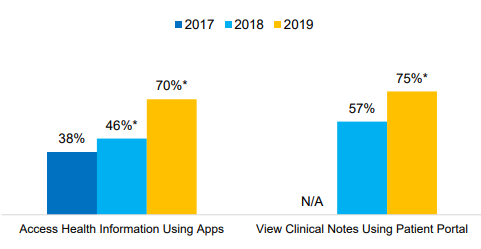
Note: Denominator represents all non-federal acute care hospitals that provide inpatient care. *Significantly different from previous year (p<0.05). The survey asked respondents about health information access for patients who received inpatient and outpatient care. Responses and statistics are presented separately for inpatient and outpatient care at hospitals. Please refer to the Definitions section of this data brief for more information on the terminology. See Appendix Table A1 for survey questions related to inpatient and outpatient care.
Nearly all hospitals enabled inpatients to electronically view their health information using a portal in 2019.
Findings
- About three-quarters of hospitals enabled inpatients to electronically view, download, and transmit health information using a portal in 2019. This has remained unchanged since 2016.
- More than nine in 10 hospitals reported that they enabled inpatients to download their health information, and about three-quarters of hospitals reported their inpatients could electronically transmit their health information to a third party.
Figure 2: Percent of non-federal acute care hospitals that enabled patients who received inpatient care to view, download, and transmit their health information electronically using a portal, 2012-2019.
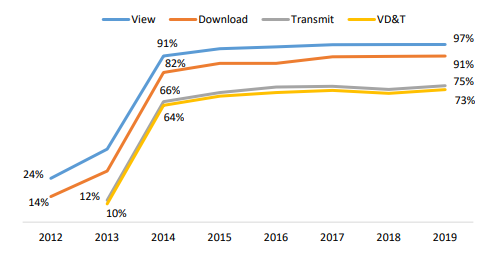
Note: Denominator represents all non-federal acute care hospitals that provide inpatient care. The survey asked respondents about health information access for patients who received inpatient and outpatient care. Responses and statistics are presented separately for inpatient and outpatient care at hospitals. Please refer to the Definitions section of this data brief for more information on the terminology. See Appendix Table A1 for survey questions related to inpatient and outpatient care. See Appendix Table A2 for specific data points for all years.
Small, rural, independent, and Critical Access hospitals enabled inpatients to access health information using apps at lower rates compared to their counterparts.
Findings
- About two in three small, rural, independent, and Critical Access hospitals enabled inpatients to access their health information using mobile or software applications.
- About three in four large, urban, and system affiliated hospitals enabled inpatients to access their health information using mobile or software applications.
- Hospitals with a 2015 Edition Certified EHR enabled inpatient electronic access to health information through an app at nearly twice the rate of hospitals without a 2015 Edition Certified EHR.
- Small, rural, independent, and Critical Access hospitals enabled inpatients to view, download, and transmit using a portal at lower rates compared to their counterparts.
Table 1: Percent of non-federal acute care hospitals that enabled patients who received inpatient care to access health information by hospital characteristics, 2019.
| View Health Information | Download Health Information | Transmit Health Information | Access Health Information Using Apps | View Clinical Notes Using Patient Portal | |
|---|---|---|---|---|---|
| Hospital Characteristics | |||||
| Small (51%) | 96%* | 88%* | 67%* | 66%* | 72%* |
| Medium-Large (49%) | 99% | 94% | 83% | 75% | 78% |
| CAH (29%) | 95%* | 89%* | 62%* | 62%* | 74% |
| non-CAH (71%) | 98% | 92% | 80% | 74% | 76% |
| Rural (40%) | 97%* | 89%* | 66%* | 68%* | 73%* |
| Suburban-Urban (60%) | 98% | 92% | 80% | 72% | 76% |
| Independent (34%) | 94%* | 88%* | 61%* | 61%* | 73%* |
| System Affiliation (66%) | 99% | 93% | 82% | 75% | 77% |
| Health IT Characteristics | |||||
| No 2015 Edition (9%) | 86%* | 71%* | 41%* | 39%* | 54%* |
| 2015 Edition (91%) | 98% | 93% | 78% | 73% | 77% |
Notes: Denominator represents all non-federal acute care hospitals that provide inpatient care. *Significantly different from corresponding category in the row below (p<0.05). The survey asked respondents about health information access for patients who received inpatient and outpatient care. Responses and statistics are presented separately for inpatient and outpatient care at hospitals. Please refer to the Definitions section of this data brief for more information on the terminology. See Appendix Table A1 for survey questions related to inpatient and outpatient care. Please refer to the Definitions section of this data brief for descriptions of each hospital characteristic.
Hospitals provided patients similar access to health information across inpatient and outpatient care settings.
Findings
- Among hospitals that provided outpatient care, 97 percent enabled outpatients to view their health information in a patient portal, 95 percent enabled outpatients to download their health information, and 75 percent enabled them to transmit their health information to a third party.
- More than eight in 10 hospitals (82%) reported that patients in their outpatient setting can view their clinical notes.
- Nearly three-quarters of hospitals (73%) reported that patients in their outpatient setting can access health information using apps.
Table 2: Percent of non-federal acute care hospitals that enabled patient electronic access to health information by type of care setting, 2019
| Patient Health Information Access | Inpatient Care | Outpatient Care |
|---|---|---|
| View, Download, and Transmit | ||
| View Health Information | 97% | 97% |
| Download Health Information | 91% | 95% |
| Electronically Transmit (Send) Health Information | 75% | 75% |
| Access and Use of Patient Access Functions | ||
| View Clinical Notes Using Patient Portal | 75% | 82% |
| Access Health Information Using Apps | 70% | 73% |
Notes: Denominator for inpatient care represents all non-federal acute care hospitals that provide inpatient care. Denominator for outpatient care represents the 98% of non-federal acute care hospitals that reported they provide outpatient care. The survey asked respondents about health information access for patients who received inpatient and outpatient care. Responses and statistics are presented separately for inpatient and outpatient care at hospitals. Please refer to the Definitions section of this data brief for more information on the terminology. See Appendix Table A1 for survey questions related to inpatient and outpatient care. See Appendix Table A3 for additional patient access to health information capabilities that hospitals enable by type of care setting.
Six in 10 hospitals that provided outpatient care enabled access to health information using apps across all outpatient sites.
Findings
- Nine in 10 hospitals enabled patients to view their health information across all outpatient care sites; whereas less than one in 10 hospitals enabled access across some outpatient sites.
- Two-thirds of hospitals that provided outpatient care enabled patients to view clinical notes at all their practice sites; whereas about 15 percent reported implementing this functionality at only some practice sites.
Figure 3: Percent of non-federal acute care hospitals that provided outpatient care by whether patient access to health information was implemented at all or some of their outpatient sites, 2019.
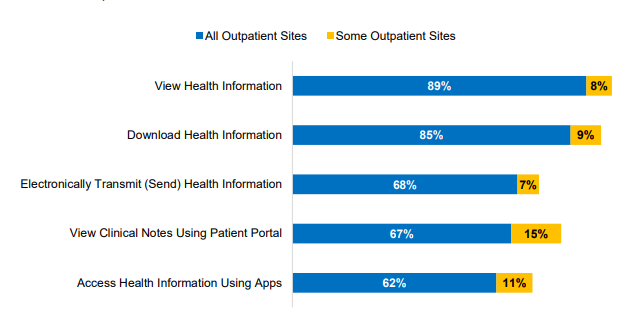
Note: Denominator represents the 98% of non-federal acute care hospitals that reported they provide outpatient care. The survey asked respondents about health information access for patients who received inpatient and outpatient care. Responses and statistics are presented separately for inpatient and outpatient care at hospitals. Please refer to the Definitions section of this data brief for more information on the terminology. See Appendix Table A1 for survey questions related to inpatient and outpatient care.
Hospitals that used the same EHR across their outpatient sites enabled patient access to health information at higher rates compared to hospitals whose outpatient sites used different EHRs.
Findings
- Seven in 10 hospitals that provide outpatient care reported that they use the same EHR across all outpatient sites, whereas three in 10 reported they used a different EHR across practice sites.
- Hospitals that reported using the same EHR across outpatient sites enabled outpatients to view clinical notes at higher rates compared to hospitals that used a different EHR across practice sites.
- Hospitals that used the same EHR across outpatient sites enabled outpatients to access health information using apps at similar rates compared to hospitals that used a different EHR across practice sites.
Figure 4: Percent of non-federal acute care hospitals that enabled patient electronic access to health information at their outpatient sites by whether they used the same or different EHRs across the practice sites, 2019
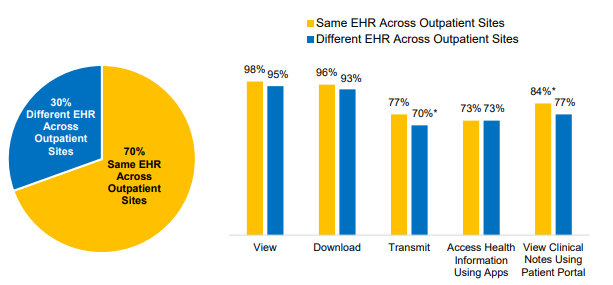
Note: Denominator represents the 98% of non-federal acute care hospitals that reported they provide outpatient care. *Significantly different from hospitals that use a different EHR across outpatient sites (p<0.05). The survey asked respondents about health information access for patients who received inpatient and outpatient care. Responses and statistics are presented separately for inpatient and outpatient care at hospitals. Please refer to the Definitions section of this data brief for more information on the terminology. See Appendix Table A1 for survey questions related to inpatient and outpatient care.
Hospitals that used the same EHR across their outpatient sites implemented patient access capabilities across all those sites at higher rates compared to hospitals whose outpatient sites used different EHRs.
Findings
- Nearly all hospitals that used the same EHR across outpatient sites enabled patients across all of their outpatient sites to view their health information in a portal. About three-quarters of hospitals that used different EHRs across outpatient sites reported this capability.
- About three-quarters of hospitals that used the same EHR across outpatient care sites enabled patients across outpatient sites to view their clinical notes using a patient portal. Less than half of hospitals that used different EHRs across outpatient sites reported enabling this capability.
Table 3: Percent of non-federal acute care hospitals that enabled patient electronic access to health information at their outpatient sites by whether they used the same or different EHRs across the practice sites, 2019
| Same EHR Across Sites (70%) | Different EHR Across Sites (30%) | |||
|---|---|---|---|---|
| Patient Engagement Functionalities | All Outpatient Sites | Some Outpatient Sites | All Outpatient Sites | Some Outpatient Sites |
| View Health Information | 95% | 3% | 75% | 20% |
| Download Health Information | 91% | 4% | 69% | 23% |
| Electronically Transmit (Send) Health Information | 74% | 3% | 56% | 14% |
| View Clinical Notes Using Patient Portal | 74% | 10% | 48% | 29% |
| Access Health Information Using Apps | 68% | 5% | 47% | 26% |
Note: Denominator represents the 98% of non-federal acute care hospitals that reported they provide outpatient care. The survey asked respondents about health information access for patients who received inpatient and outpatient care. Responses and statistics are presented separately for inpatient and outpatient care at hospitals. Please refer to the Definitions section of this data brief for more information on the terminology. See Appendix Table A1 for survey questions related to inpatient and outpatient care. See Appendix Table A4 for additional patient access to health information capabilities that hospitals enable by whether they implemented the same or different EHRs across outpatient practice sites.
Summary
Patient medical records are now digitized across nearly all hospitals in the U.S. (3). Federal programs, such as the CMS Promoting Interoperability Program (formerly known as the Medicare and Medicaid EHR Incentive Program), have helped incent hospitals to adopt certified health IT that enables patients to access their health information electronically. The 21st Century Cures Act further builds on this foundation and modernizes the methods patients can use to access their health information and the ways their health care providers can enable this electronic access (4). This data brief shows that in 2019, 70 percent of hospitals reported they enabled their inpatients to access their health information through a mobile or software application—this represents a nearly 50% increase from 2018.
In 2019, nearly all hospitals enabled patients to electronically view their health information using an online portal. About nine in 10 hospitals enabled patients to download their health information. However, hospitals’ rates of enabling patients to transmit (or send) health information electronically to a third party from their portal remains lower. The proportion of hospitals that enabled patients to view, download, and transmit their health information electronically has remained largely unchanged since 2016.
Although nine in 10 hospitals possess certified EHR technology that provides them with the technical capability to transmit their health information electronically, only three-quarters of hospitals reported that they had enabled this functionality in 2019. Previous research has found that, although many hospitals and ambulatory practice groups have technology that is capable of connecting patients with their medical record online, not all providers fulfill patient requests to get an electronic copy of their record or enable patients to access their health information electronically (5-6).
Disparities also exist in the implementation of patient engagement functionalities across hospitals. Consistent with past findings, small, rural, independent and Critical Access hospitals enabled patient electronic access to health information using both portals and APIs at lower rates than other hospitals (7). This indicates that gaps in access may be due to hospital resources, technical knowledge, and other technology issues unrelated to the capabilities of certified EHRs.
Hospitals provided patients with electronic access to their health information at similar rates in both inpatient and outpatient care settings. However, hospitals differed in patient electronic access to health information in outpatient settings depending on whether or not the hospital used the same EHR across all of its outpatient sites. Thirty percent of hospitals reported using different EHRs across their outpatient sites. Only 75 percent of these hospitals reported that all their outpatient sites enabled patients to view their health information in a portal compared to 95 percent among hospitals that used the same EHR across outpatient sites. This may reflect a lack of connectivity or technological capability to enable patients to access capabilities between the different EHRs. Implementation of standards-based APIs could reduce variation in the enablement of patient access capabilities across disparate EHR systems.
In 2020, ONC published its 21st Century Cures Act Final Rule (8). This rule requires certain health IT developers to certify their health IT products to secure, standards-based APIs, which will allow patients to more easily access their health information using smartphone applications. This analysis found hospitals that used 2015 Edition certified health IT reported higher rates of patient access compared to hospitals that did not use 2015 Edition certified health IT. As the new ONC Cures Act Final Rule requirements are implemented, it will be important to continue to monitor these trends to ensure hospitals enable patients with technology and health information access to better manage their health care.
Definitions
Non-federal acute care hospital: Hospitals that meet the following criteria: acute care general medical and surgical, children’s general, and cancer hospitals owned by private/not-for-profit, investor-owned/for-profit, or state/local government and located within the 50 states and District of Columbia.
Small hospital: Non-federal acute care hospitals of bed sizes of 100 or less.
Rural hospital: Hospitals located in a non-metropolitan statistical area.
Critical Access Hospital: Hospitals with less than 25 beds and at least 35 miles away from another general or critical access hospital.
System affiliated hospital: A system is defined as either a multi-hospital or a diversified single hospital system. A multi-hospital system is two or more hospitals owned, leased, sponsored, or contract managed by a central organization. Single, freestanding hospitals may be categorized as a system by bringing into membership three or more, and at least 25 percent, of their owned or leased non-hospital pre-acute or post acute health care organizations.
Inpatient: A patient who is admitted to a hospital to undergo treatment. The survey asks about “patients who receive inpatient care provided by your hospital”. Inpatients refer to patients who receive inpatient care from respondent hospital. Please refer to Appendix Table A1 to review the applicable questions.
Outpatient: A patient who receives treatment and is not admitted to a hospital. The survey asks about “patients who receive outpatient care provided by your hospital”. Outpatients refer to patients who receive outpatient care from respondent hospital. Please refer to Appendix Table A1 to review the applicable questions.
Outpatient sites: Sites or locations within a hospital’s campus or care facility that provide outpatient treatment. These sites may include emergency rooms, laboratories, and imaging rooms.
2015 Edition Certified Electronic Health Record (EHR): An EHR that meets certification criteria requirements established by the U.S. Department of Health and Human Services. These criteria establish the required capabilities, standards, and implementation specifications that health information technology needs to meet in order to become certified under the ONC Health IT Certification Program. Certified health IT products can be used for participation in CMS quality reporting programs and State Promoting Interoperability Programs.
Data Source and Methods
Data are from the American Hospital Association (AHA) Information Technology (IT) Supplement to the AHA Annual Survey. Since 2008, ONC has partnered with the AHA to measure the adoption and use of health IT in U.S. hospitals. ONC funded the 2019 AHA IT Supplement to track hospital adoption and use of EHRs and the exchange of clinical data.
The chief executive officer of each U.S. hospital was invited to participate in the survey regardless of AHA membership status. The person most knowledgeable about the hospital’s health IT (typically the chief information officer) was requested to provide the information via a mail survey or secure online site. Non respondents received follow-up mailings and phone calls to encourage response.
The survey was fielded from the beginning of January 2020 to the end of June 2020. The response rate for non-federal acute care hospitals was 59 percent. A logistic regression model was used to predict the propensity of survey response as a function of hospital characteristics, including size, ownership, teaching status, system membership, and availability of a cardiac intensive care unit, urban status, and region. Hospital-level weights were derived by the inverse of the predicted propensity.
References
1. Office of the National Coordinator for Health Information Technology. About the ONC Certification Program. https://www.healthit.gov/topic/certification-ehrs/about-onc-health-it-certification-program
2. Centers for Medicare and Medicaid Services (CMS). Promoting Interoperability Programs. https://www.cms.gov/Regulations-and-Guidance/Legislation/EHRIncentivePrograms
3. Office of the National Coordinator for Health Information Technology. ‘Non-federal Acute Care Hospital Electronic Health Record Adoption,’ Health IT Quick-Stat #47. September 2017. https://dashboard.healthit.gov/quickstats/pages/FIG-Hospital-EHR-Adoption.php
4. 21st Century Cures Act, section 4006. https://www.congress.gov/114/statute/STATUTE-130/STATUTE-130-Pg1033.pdf.
5. Lye et al. Assessment of US Hospital Compliance With Regulations for Patients’ Requests for Medical Records. JAMA Network Open. 2018;1(6):e183014.
6. McGraw D., Fitter N., & Taylor L.B. Health Care Provider Compliance with the HIPAA Right of Individual Access: a Scorecard and Survey. 2019. medRxiv 19004291.
7. Henry J., Barker, W., & Kachay, L. (April 2019) Electronic Capabilities for Patient Engagement among U.S. Non-Federal Acute Care Hospitals: 2013-2017. ONC Data Brief, no. 45. Office of the National Coordinator for Health Information Technology: Washington DC.
8. Office of the National Coordinator for Health IT. ONC Cures Act Final Rule. https://www.federalregister.gov/documents/2020/05/01/2020-07419/21st-century-cures-actinteroperability-information-blocking-and-the-onc-health-it-certification
Acknowledgements
The authors are with the Office of Technology, within the Office of the National Coordinator for Health Information Technology. The data brief was drafted under the direction of Mera Choi, Director of Technical Strategy and Analysis, Talisha Searcy, Deputy Director of Technical Strategy and Analysis, and Vaishali Patel, Branch Chief of the Data Analysis Branch.
Suggested Citation
Johnson C. & Barker W. (June 2021). Hospital Capabilities to Enable Patient Electronic Access to Health Information, 2019. ONC Data Brief, no.55. Office of the National Coordinator for Health Information Technology: Washington DC
Appendix Table A1: Survey questions assessing hospital capabilities to enable patient electronic access to health information
| Question Text | Response Options |
|---|---|
| Are patients who receive inpatient care provided by your hospital able to do the following: (Check “Yes” only if the functionality has been “turned on” and is fully implemented and available to patients.) |
Yes | No | Do not know
|
| Does your hospital provide outpatient care to patients? |
|
| Is there more than one primary EMR/EHR system in use across your outpatient site(s)? |
|
| To what extent are patients who receive outpatient care provided by your hospital able to do the following: (Check “Yes” only if the functionality has been “turned on” and is fully implemented and available to patients.) |
Yes, at all outpatient site(s) | Yes, across some outpatient site(s) | No, across none of the outpatient site(s)| Do not know
|
Appendix Table A2: Percent of non-federal acute care hospitals that enabled patients to view, download, and transmit health information in their portal, 2012-2019.
| Year | View | Download | Transmit | VD&T |
|---|---|---|---|---|
| 2012 | 24% | 14% | – | – |
| 2013 | 40%* | 28%* | 12% | 10% |
| 2014 | 91%* | 82%* | 66%* | 64%* |
| 2015 | 95%* | 87%* | 71%* | 69%* |
| 2016 | 96% | 87% | 74%* | 71%* |
| 2017 | 97% | 91%* | 74% | 72% |
| 2018 | 97% | 91% | 73% | 71% |
| 2019 | 97% | 91% | 75%* | 73%* |
Note: *Statistically significantly different from prior year (p < 0.05).
Appendix Table A3: Percent of non-federal acute care hospitals that enabled patient electronic access to health information by type of setting, 2019
| Patient Health Information Access – Updating or Adding Information to Health Record | Inpatient Care | Outpatient Care |
|---|---|---|
| Import Medical Records from Other Organizations | 46% | 53% |
| Change/Update Medical Record | 71% | 73% |
| Submit Patient Generated Data (e.g., Blood Glucose) | NA | 63% |
| Access and Use of Patient Access Functions | ||
| Designate Family Member or Caregiver Access for Patient Portal | 89% | 90% |
| Send/Receive Secure Messages with Providers within Patient Portal | NA | 88% |
| Convenience Functions | ||
| Pay Bills Online | 86% | 87% |
| Request Refills for Prescriptions | NA | 73% |
| Schedule Appointments | NA | 73% |
Notes: Denominator for inpatient care represents all non-federal acute care hospitals that provide inpatient care. Denominator for outpatient care represents the 98% of non-federal acute care hospitals that reported they provide outpatient care.
Appendix Table A4: Percent of non-federal acute care hospitals that enabled patient electronic access to health information at all or some of their outpatient sites and by whether they implemented the same EHR across all outpatient sites, 2019
| Same EHR Across Sites (70%) | Different EHR Across Sites (30%) | |||
|---|---|---|---|---|
| Electronic Patient Health Information Access | All Outpatient Sites | Some Outpatient Sites | All Outpatient Sites | Some Outpatient Sites |
| Updating or Adding Information to Health Record | ||||
| Import Medical Records from Other Organizations | 49% | 5% | 32% | 19% |
| Change/Update Medical Record | 73% | 3% | 47% | 18% |
| Submit Patient Generated Data (e.g., Blood Glucose) | 60% | 7% | 30% | 23% |
| Access and Use of Patient Access Functions | ||||
| Designate Family Member or Caregiver Access | 90% | 3% | 62% | 21% |
| Send/Receive Secure Messages with Providers | 87% | 4% | 54% | 29% |
| Convenience Functions | ||||
| Pay Bills Online | 87% | 3% | 63% | 17% |
| Request Refills for Prescriptions | 71% | 4% | 48% | 21% |
| Schedule Appointments | 63% | 15% | 34% | 25% |
Note: Denominator represents the 98% of non-federal acute care hospitals that reported they provide outpatient care.