



Information Blocking
Most clinical information is digitized, accessible, and shareable thanks to several technology and policy advances making interoperable, electronic health record systems widely available. In 2016, the 21st Century Cures Act (Cures Act) made sharing electronic health information the expected norm in health care and authorized the Secretary of Health and Human Services (HHS) to identify “reasonable and necessary activities that do not constitute information blocking.” Information blocking exceptions are identified in 45 CFR Part 171.

What Is Information Blocking and to Whom Does It Apply?
Information blocking is a practice by an “actor” that is likely to interfere with the access, exchange, or use of electronic health information (EHI), except as required by law or specified in an information blocking exception. The Cures Act applied the law to healthcare providers, health IT developers of certified health IT, and health information exchanges (HIEs)/health information networks (HINs).
It is also important to note that the Cures Act established two different “knowledge” standards for actors’ practices within the statute’s definition of “information blocking.” In particular, for health IT developers of certified health IT, as well as HIEs/HINs, the law applies the standard of whether they know, or should know, that a practice is likely to interfere with the access, exchange, or use of EHI. For healthcare providers, the law applies the standard of whether they know that the practice is unreasonable and is likely to interfere with the access, exchange, or use of EHI.


The exact regulatory definition of Information Blocking can be found in the Code of Federal Regulations in 45 CFR 171.103.
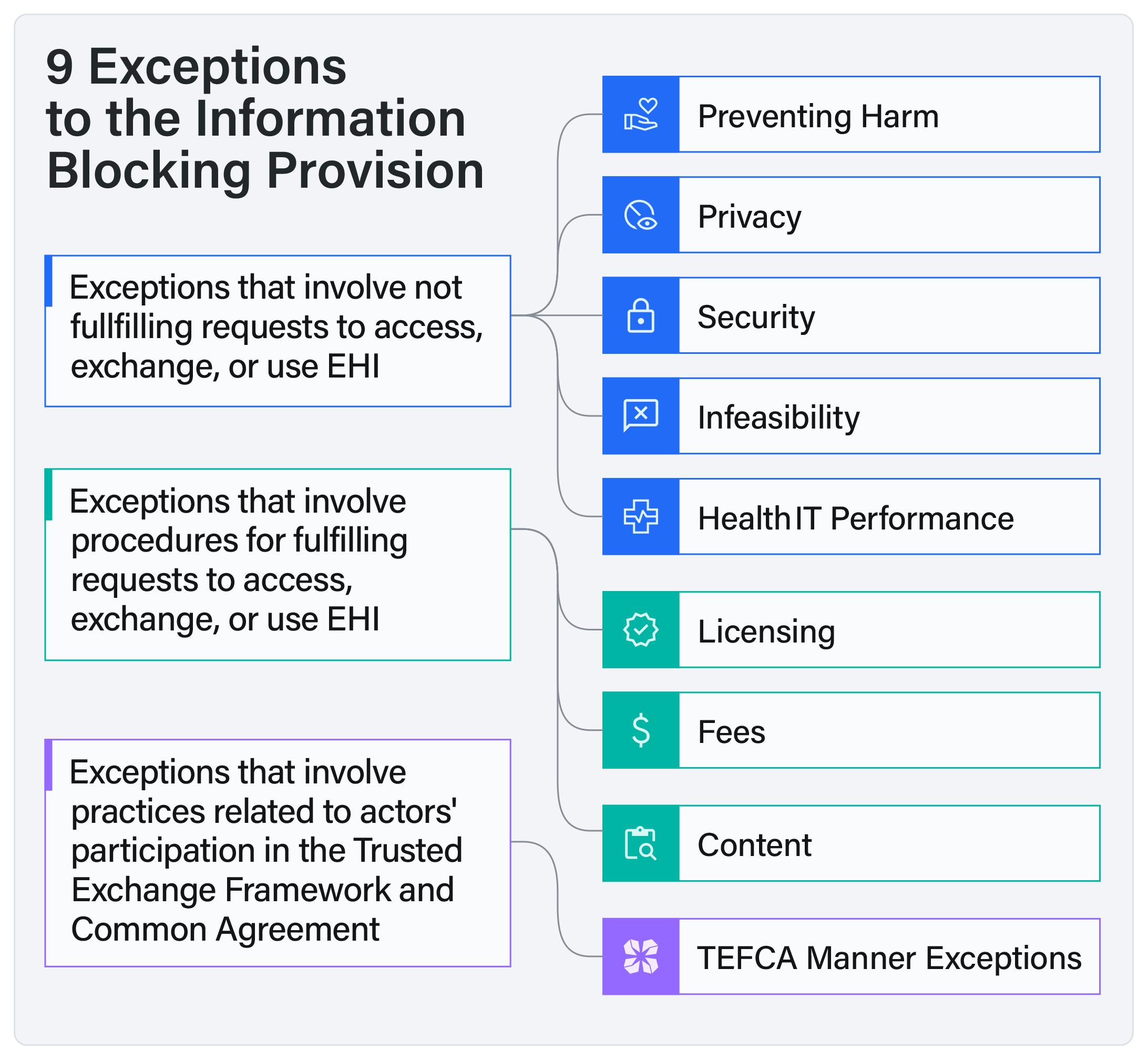
Information Blocking Exceptions
Information blocking exceptions are identified in 45 CFR Part 171. When an actor’s practice meets an exception, it will not be considered information blocking. Importantly, the information blocking exceptions are voluntary and offer actors certainty, but it is also worth noting that even in cases where a practice does not meet any of the exceptions it does not automatically mean that information blocking has occurred. Instead, such practices will be evaluated on a case-by-case basis to determine whether information blocking has occurred. Learn more about elements of whether information blocking occurred in cases where no exception has been met.
How Do I Submit an Information Blocking Claim and What Happens to a Claim Once It Is Submitted?
Information blocking claims can be submitted online through ASTP/ONC’s Report Information Blocking Portal.
By law, information received by ASTP/ONC in connection with a claim or suggestion of possible information blocking that could identity who submitted the claim is exempt from mandatory disclosure under the Freedom of Information Act.
ASTP/ONC has authority to review claims of possible information blocking against health IT developers of certified health IT that may constitute a non-conformity under the ONC Health IT Certification Program. Separately, the HHS OIG has authority to investigate claims of possible information blocking across all types of actors: health care providers, health information networks and health information exchanges, and health IT developers of certified health IT.

Information Blocking Provider Disincentives
The U.S. Department of Health and Human Services (HHS) released a final rule establishing disincentives for health care providers found by the HHS Office of Inspector General (OIG) to have committed information blocking. This implements the HHS Secretary’s authority under section 4004 of the 21st Century Cures Act (Cures Act) to establish “disincentives” for providers who knowingly and unreasonably interfere with the access, exchange, or use of electronic health information (EHI) except as required by law or covered by a regulatory exception.


Information Blocking Resources







Frequently Asked Questions
Filter by Category
- Eligibility 2
- Provider Requirements 1
- Privacy & Security 2
- Cost & Technology Needs 2
- Benefits 2
- HHS Health IT Alignment Program 10
- General 10
- Information Blocking 53
- General 7
- Actors 7
- Electronic Health Information 9
- Interference 13
- Exceptions – General 2
- Manner Exception 1
- Preventing Harm Exception 6
- Enforcement 2
- Reporting Claims of Information Blocking 4
- Privacy Exception 3
Certification
The Cures Act requires ONC to establish certain Conditions and Maintenance of Certification requirements for health IT developers under the ONC Health IT Certification Program. Per these Conditions and Maintenance of Certification, a health IT developer who participates in the ONC Health IT Certification Program may not take any actions that constitutes “information blocking” as defined in Section 3022(a) of the Public Health Service Act (PHSA) and 45 CFR 171.103.
The materials contained on this webpage are based on the provisions contained in 45 C.F.R. Parts 170 and 171. While every effort has been made to ensure the accuracy of this restatement of those provisions, this webpage is not a legal document. The official program requirements are contained in the relevant laws and regulations. Please note that other Federal, state and local laws may also apply.